Practice session
Sharing the road
Loading…
Every question on this page
The whole pool, with the answer and the explanation for each one. Practise first, then read through anything you were unsure of.
Show all 22 questions with answers
1 of 22 · Sharing the road
You are approaching a school bus from the front on a road with several lanes. Its red lights at the top are flashing alternately. What must you do?
- A.Stop — vehicles in all lanes must stop, from either directionAnswer
- B.Slow down and pass carefully, because you are coming from the front
- C.Stop only if you are in the lane next to the bus
- D.Stop only if you see children crossing
Explanation: Alternating flashing red lights at the top of a school bus mean every vehicle must stop — whether it is approaching from the front or the rear, and in every lane. Children may cross in front of or behind the bus.
2 of 22 · Sharing the road
The amber lights at the top of a school bus ahead start flashing alternately. What do they warn you of?
- A.The driver is preparing to stopAnswer
- B.The children have finished crossing
- C.The bus is about to pull away, so you may pass it now
- D.The bus has broken down
Explanation: Alternating flashing amber lights mean the school bus driver is getting ready to stop. Slow down and be prepared to stop, because the red lights will come on next.
3 of 22 · Sharing the road
You have stopped for a school bus with flashing red lights. When may you start moving again?
- A.When the bus moves on, or the driver turns off the lights and pulls in the stop signAnswer
- B.As soon as the children you saw reach the sidewalk
- C.When the vehicle behind you sounds its horn
- D.After the bus driver waves at you, even with the red lights still flashing
Explanation: Stay stopped until the bus moves on, or until the driver shows it is safe by turning off the flashing lights and pulling in the stop sign. A child you cannot see may still be crossing.
4 of 22 · Sharing the road
An ambulance with its siren and flashing lights is coming up behind you on a two-way street. What is usually the best thing to do?
- A.Pull over to the right and stopAnswer
- B.Speed up to stay ahead of it
- C.Stop right where you are, even in an intersection
- D.Keep going at the same speed and let it find a way around you
Explanation: Emergency vehicles using lights and sirens always have the right-of-way. Clear a path by pulling over to the right and stopping — but never stop in an intersection. Signal so the driver knows you have seen the vehicle.
5 of 22 · Sharing the road
You are driving on a divided highway. A police car with lights and siren is approaching on the other side of the median. What does the rule say?
- A.You may not need to stop, as long as it could not possibly cross onto your sideAnswer
- B.You must stop in your lane until it has passed
- C.You must pull over to the left shoulder
- D.You must speed up to clear the area
Explanation: Normally all traffic in both directions must stop for an emergency vehicle. The exception is a divided highway where the vehicle is on the other side of the median — make sure it would be impossible for it to move onto your side.
6 of 22 · Sharing the road
You are following a fire truck. How far back must you stay?
- A.At least 150 metresAnswer
- B.At least 50 metres
- C.At least 2 seconds
- D.At least 500 metres
Explanation: When you follow a fire truck you must stay back at least 150 metres, so you do not get in the way when it stops or turns and firefighters have room to work.
7 of 22 · Sharing the road
A fire hose is stretched across the road in front of you. What does the law say?
- A.You must not drive over itAnswer
- B.You may drive over it slowly
- C.You may drive over it if no firefighter is nearby
- D.You may drive over it if the hose looks empty
Explanation: It is illegal to drive over a fire hose. Driving over it can damage it or cut the water supply firefighters depend on — find another way or wait.
8 of 22 · Sharing the road
The speed limit is 90 km/h. A tow truck is stopped on the shoulder with its lights flashing. What is the fastest you may drive past it?
- A.70 km/hAnswer
- B.40 km/h
- C.80 km/h
- D.90 km/h, the posted limit
Explanation: Where the speed limit is 80 km/h or more, you must drive no faster than 70 km/h when passing a stopped vehicle with flashing lights, such as a tow truck, police car or highway maintenance vehicle.
9 of 22 · Sharing the road
On a street signed at 60 km/h, a utility truck is stopped at the side with yellow lights flashing. What is the fastest you may drive past it?
- A.40 km/hAnswer
- B.50 km/h
- C.60 km/h, the posted limit
- D.20 km/h
Explanation: Where the speed limit is less than 80 km/h, you must drive no faster than 40 km/h past a stopped vehicle displaying flashing lights. The rule covers utility workers, tow trucks, garbage collectors and many others.
10 of 22 · Sharing the road
You are in the lane nearest to a police car stopped at the roadside with its lights flashing. Besides slowing down, what must you do?
- A.Change lanes, if it is safe to do soAnswer
- B.Stop beside it until the officer waves you on
- C.Sound your horn to warn the officer
- D.Nothing more — slowing down is all that is required
Explanation: If you are in the lane next to a stopped vehicle with flashing lights, you must also move over to another lane when it is safe. Failing to slow down or change lanes can bring a traffic violation and penalty points.
11 of 22 · Sharing the road
A transit bus is signalling and showing a yield-to-bus sign as it leaves a bus stop. On which roads must you let it pull out?
- A.On all roads where the speed limit is 60 km/h or lowerAnswer
- B.Only on roads where the speed limit is 30 km/h
- C.Only where there is a bus lane
- D.Never — the bus must wait for a gap like any other vehicle
Explanation: On roads with a speed limit of 60 km/h or lower, you must let a signalling bus with a yield-to-bus sign move out from the curb lane or a stop. Change lanes if there is room, or slow down.
12 of 22 · Sharing the road
How much space should you leave beside a cyclist when you pass?
- A.As much as possible — at least one metre, and more at higher speedAnswer
- B.Just enough for your mirror to clear the handlebars
- C.About 30 centimetres
- D.None — cyclists must pull onto the shoulder to let you pass
Explanation: When passing pedestrians, cyclists or other vehicles, give as much room as you can — at least one metre, and more if you are going faster. Many crashes with cyclists are side-swipes.
13 of 22 · Sharing the road
On a narrow two-lane road with a single solid yellow centre line, you come up behind a cyclist. What does B.C. law allow?
- A.You may cross the line to pass the cyclist, provided you can do it safelyAnswer
- B.You may never cross a solid yellow line, so you must stay behind
- C.You may squeeze past within your own lane
- D.Sound your horn so the cyclist moves onto the shoulder
Explanation: You are allowed to cross a single solid yellow line to pass a cyclist, as long as you can do it safely. On a narrow road, wait for a clear, straight stretch so you can pull out and give the cyclist room.
14 of 22 · Sharing the road
A cyclist ahead of you extends the right arm straight out. What is the cyclist telling you?
- A.The cyclist is going to turn rightAnswer
- B.The cyclist is going to turn left
- C.The cyclist is going to stop
- D.The cyclist wants you to pass on the right
Explanation: Cyclists may signal a right turn by holding the right arm straight out. Learn the hand signals cyclists use so you can predict their next move and give them room.
15 of 22 · Sharing the road
A person with a white cane at the curb raises the cane. What should you do?
- A.Stop and give the person the right-of-wayAnswer
- B.Sound your horn so the person knows where you are
- C.Keep going — the person is waving you through
- D.Rev your engine so the person can hear your vehicle
Explanation: A visually impaired person often raises the cane when unsure about crossing safely. That is your signal to stop and let them cross. Do not startle them or a guide dog by racing the engine or honking.
16 of 22 · Sharing the road
You are turning at an intersection that has no marked crosswalk. A pedestrian is crossing near your half of the road. Who has the right-of-way?
- A.The pedestrian — no marked crosswalk is neededAnswer
- B.You do, because there is no marked crosswalk
- C.Whoever reached the intersection first
- D.You do, as long as your light is green
Explanation: At intersections, pedestrians near your half of the road have the right-of-way even when there is no marked crosswalk, and you must also yield to them when turning. It is always the driver’s responsibility to avoid hitting a pedestrian.
17 of 22 · Sharing the road
Which statement about sharing a lane with a motorcycle is correct?
- A.Never do it — a motorcycle needs the whole laneAnswer
- B.It is fine if the rider keeps to one side of the lane
- C.It is allowed in slow, heavy traffic
- D.It is allowed if the rider waves you alongside
Explanation: Never try to share a lane with a motorcycle: it needs the whole lane to travel safely. Riders often use the left part of the lane simply to be more visible, not to invite you in.
18 of 22 · Sharing the road
You are following a large truck. How can you tell you are not in the driver’s blind spot behind it?
- A.You can see both of the truck’s side mirrorsAnswer
- B.You can see the truck’s brake lights
- C.You are close enough to read its licence plate
- D.Your headlights are on
Explanation: Large vehicles have big blind spots behind and beside them. If you can see both mirrors of the truck or bus ahead, the driver has a chance of seeing you; staying farther back also widens your own view of the road ahead.
19 of 22 · Sharing the road
A large truck ahead of you may be about to turn right. Where should you avoid being?
- A.On its right side, between the truck and the curbAnswer
- B.Well behind it, where you can see both mirrors
- C.In the lane to its left, well back
- D.Stopped behind the stop line
Explanation: Big vehicles need a lot of room to turn. When a truck turns right it may swing wide first, and a car on its right can be squeezed between the truck and the curb.
20 of 22 · Sharing the road
The lights are flashing at a railway crossing ahead. Where should you stop?
- A.No closer than 5 metres and no farther than 15 metres from the nearest railAnswer
- B.Right at the edge of the nearest rail
- C.At least 30 metres from the nearest rail
- D.Between the two sets of tracks, if there is room
Explanation: Stop no closer than 5 metres and no farther than 15 metres from the nearest rail. Trains always have the right of way; wait until it is safe, and watch for a second train on another track.
21 of 22 · Sharing the road
Your vehicle is stuck on a railway track. After getting everyone out, what should you do?
- A.Move quickly at least 30 metres away from the track, then phone for helpAnswer
- B.Stand beside the vehicle and wave at the train
- C.Try to push the vehicle off the track together
- D.Get back in and keep trying to start the engine
Explanation: Get everyone out and move quickly at least 30 metres away from the track to avoid flying debris. Then call the number on the back of the railway crossing sign, or 911 or the local police, and report the location.
22 of 22 · Sharing the road
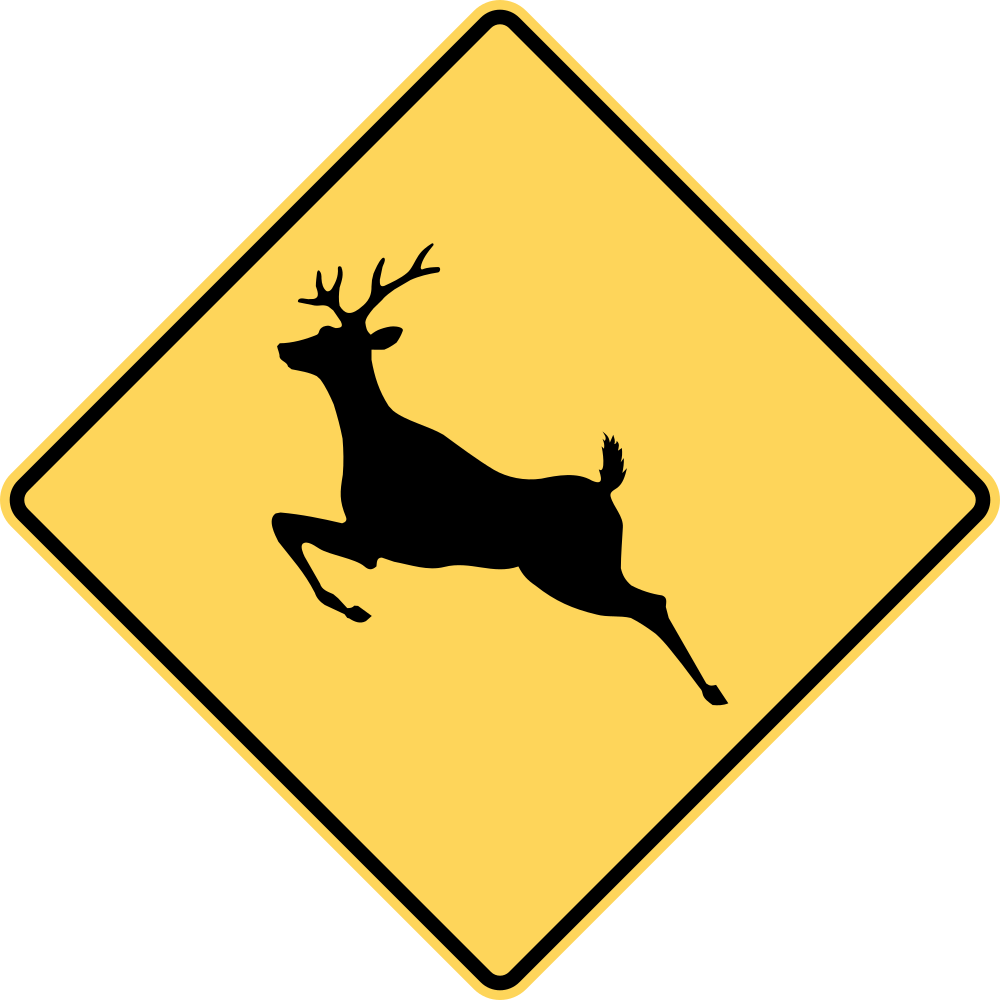
You are driving through the area this sign marks. At which times should you be most cautious?
- A.At dusk and dawnAnswer
- B.Only in the middle of the day
- C.Only in winter
- D.Only when you can already see an animal
Explanation: Animals move around to feed at dusk and dawn, and they are harder to see then. Slow down in marked areas, scan the sides of the road, and remember that wild animals often move in herds — where there is one, there may be more.