1.Driver penalty points and the premium
- Penalty points are recorded on your driving record whenever you are convicted of a traffic offence, and each offence carries its own number of points. Paying a ticket means accepting both the guilt and the points; the only way to dispute the points is to dispute the ticket itself.
- Tickets and points stay on your driving record for 5 years.
- Each year ICBC adds up the points you collected during a 12-month assessment period. If you collect more than 3 points in that period you are billed a Driver Penalty Point (DPP) premium; 0 to 3 points costs nothing, and the more points you have, the more you pay.
- The DPP premium is separate from your Autoplan insurance: it is billed even if you do not own or insure a vehicle, and you have 30 days from the invoice date to pay it.
- You pay a Driver Risk Premium instead if you have 1 or more Criminal Code driving convictions or 10-point Motor Vehicle Act convictions, 1 or more excessive speeding convictions, or 2 or more roadside suspensions; it is assessed on your offences over a 3-year period. An offence such as excessive speeding can count under both programs, and you are billed once a year under whichever produces the higher premium.
- You can reduce or eliminate a DPP premium by giving up your licence: surrendering it for 1 year from your birthday eliminates the premium, giving it up for at least 30 days during the billing period reduces it, and a suspension or prohibition of 60 days or more also qualifies you for a reduction — but there are fees to reinstate your licence.
- The guide's own example bill shows how quickly it adds up. The fines in the table include the 15 per cent victim surcharge levy, most fines can be reduced by $25 if paid within 30 days, and a passenger who refuses a seatbelt is fined $167 — but if the passenger is under 16, the driver gets the fine.
| Offence (guide example) | Fine | Penalty points |
|---|---|---|
| Speeding in a school zone (1 to 20 km/h over the limit) | $196 | 3 |
| Speeding (1 to 20 km/h over the limit) | $138 | 3 |
| Going through a red light | $167 | 2 |
| Improper turn at an intersection | $109 | 3 |
| Passing without a clear view | $109 | 3 |
| Failing to yield to a pedestrian | $167 | 3 |
| Using an electronic device | $368 | 4 |
| Total | $1,254 | 21 |
Signs in this section
Official source: Driver penalty points ↗ · Your licence ↗
2.Driving prohibitions and the Driver Improvement Program
- A driving prohibition makes it illegal for you to drive for a set period. Prohibitions are issued by RoadSafetyBC, which can also impose other interventions and refer drivers to programs to improve their driving.
- RoadSafetyBC runs the Driver Improvement Program: every offence entered on your record is reviewed case by case. A driver who keeps offending may get a warning letter, then be placed on probation, and then be prohibited for a specific period if there are more offences during probation.
- A driver who racks up offences quickly can be prohibited without any previous warning, and the threshold for intervention is more stringent for drivers in the Graduated Licensing Program.
- Roadside prohibitions for impairment come in several lengths: a 24-hour roadside prohibition for drivers impaired by alcohol, drugs or both; an immediate roadside prohibition of 3, 7, 30 or 90 days issued at the roadside to alcohol-impaired drivers under the Motor Vehicle Act; and a 90-day administrative driving prohibition for impaired drivers. Criminal charges can be laid separately.
- Repeat unlicensed driving can bring an unlicensed driver prohibition that lasts indefinitely, until the driver becomes licensed. Driver Improvement Program prohibitions for a poor driving record are set individually for each case.
- If you are caught driving while prohibited, your vehicle can be impounded and you may face fines or a jail term. After any prohibition there is a $250 fee to have your licence reinstated.
- You may be able to apply online for a review of an immediate roadside prohibition, an administrative driving prohibition or an unlicensed driver prohibition.
Official source: Your licence ↗ · Driver prohibitions ↗
3.Extra penalties for L and N drivers
- As a new driver your record is closely monitored by the Superintendent of Motor Vehicles. A single traffic ticket or other driving offence can bring a warning letter, probation or a prohibition from driving, on top of the regular penalties every driver faces.
- Breaking any learner or novice restriction — or speeding or committing another traffic violation — means a fine and penalty points on your driving record. Not following the restrictions can also extend the time you spend in graduated licensing.
- More points or a more serious offence can result in a prohibition from driving for 1 month to a year or more.
- Breaking the zero alcohol or zero drug restriction brings an immediate roadside suspension or prohibition, and can also mean a fine, penalty points and having your vehicle impounded. The suspension and the points go on your record and may lead to a much longer prohibition; further violations bring even longer ones.
- A prohibition in the learner stage extends that stage: no time counts toward the novice stage until you have served the prohibition and had your licence reinstated.
- A prohibition in the novice stage resets the clock to zero: you lose all the time you had accumulated and must be prohibition-free for another 24 consecutive months before you can leave GLP.
- From October 19, 2026 a clean record is also what gets you out of GLP: the Driving Record Assessment that replaces the second road test requires no convictions for excessive speed or electronic-device use and no prohibitions or suspensions during your months of safe driving.
Official source: Your licence ↗ · Get your l ↗ · Graduated licensing ↗ · Glp changes ↗
4.Alcohol and drugs: penalties for every driver
- Impaired driving is one of the major causes of crashes in B.C., killing more than 100 people each year and injuring thousands more. There are penalties under B.C.'s Motor Vehicle Act and under the Criminal Code of Canada.
- Immediate and severe penalties apply if you drive with a certain amount of alcohol or drugs in your system or refuse to provide a breath sample, and they get more severe for repeat offences. Even the first time you are caught, the penalties add up to $600 to over $4,000, plus time off the road.
- A police officer can prohibit you from driving simply because your ability to drive appears affected by alcohol or drugs: you do not need a blood alcohol content over .08 or a blood drug concentration of 2 nanograms or more of THC.
- Under the Criminal Code, a first conviction for impaired driving, driving with a blood alcohol content over .08 or refusing to provide a sample brings a driving prohibition of 1 to 3 years, a fine of $1,000 and up, and up to 5 years in jail. Second and third convictions bring longer prohibitions, no maximum fine, and minimum jail terms.
- Impaired driving causing bodily harm carries up to 10 years of driving prohibition and up to 10 years in jail; causing death carries up to a lifetime prohibition and up to life imprisonment.
- A conviction costs more than the penalties: if you cause a crash your insurance claim can be denied and you pay for the damage yourself, your insurance rates rise and you get a driver penalty bill, you may be barred from certain jobs, and you can have trouble travelling to countries such as the U.S. and Mexico.
- Only time lowers your blood alcohol content — food, coffee, a cold shower or exercise will not. From a BAC of .08 it takes about 6 hours to get back to zero, a glass of beer has as much alcohol as a glass of wine or an average cocktail, and even small amounts can leave a driver impaired.
| Criminal Code conviction | Driving prohibition | Fine | Jail |
|---|---|---|---|
| 1st offence | 1 to 3 years | $1,000 and up | 0 to 5 years |
| 2nd offence | 2 to 5 years | No maximum | 30 days to 5 years |
| 3rd offence | 3 years to lifetime | No maximum | 4 months to 5 years |
| Causing bodily harm | Up to 10 years | No maximum | Up to 10 years |
| Causing death | Up to lifetime | No maximum | Up to life imprisonment |
Official source: Your licence ↗ · Personal strategies ↗
5.Electronic devices and distracted driving
- All B.C. drivers are prohibited by law from using hand-held electronic devices while driving: you may not operate, view or hold a cellphone or other communication device, send or read emails or texts, hold a hand-held music or gaming device, or manually program or adjust a GPS.
- The law applies whenever you are in control of the vehicle — even when you are stopped at a red light or in bumper-to-bumper traffic. Stopped at an intersection or slowed in traffic, you are still driving.
- L and N drivers are also banned from hands-free devices: no personal electronic devices at any time, including hands-free phones, Bluetooth or wired headsets, one-touch speakerphone, earbuds, programming a GPS or selecting music. The only exception is calling 911 to report an emergency.
- The penalty for using a hand-held device is a fine and penalty points. The guide's example bill shows what that looked like: $368 and 4 points for using an electronic device, a fine that took effect June 1, 2016.
- For a GLP driver a single device ticket is enough to have your driving record reviewed, and you may face a driving prohibition.
- Drivers talking on a cellphone lose about 50 per cent of what is going on around them visually. Leave your phone alone: turn it off, let calls go to voicemail, assign a passenger as your designated texter, or pull over and stop before you use any device.
Official source: Personal strategies ↗ · Graduated licensing ↗ · Get your l ↗ · Your licence ↗
6.Excessive speeding, street racing and vehicle impoundment
- Excessive speeding means driving 40 km/h or more over the posted limit. Police can impound the vehicle you are driving for it on the spot, just as they impound vehicles driven by impaired drivers.
- The other impoundment offences are driving while unlicensed, driving while suspended or prohibited, street racing or stunt driving, and riding — or letting a passenger ride — while improperly seated.
- The vehicle is impounded immediately for 7 days, which can escalate to 30 or 60 days for repeat offenders, and the owner must pay the towing and storage fees to get it back.
- Owners are responsible for making sure only licensed drivers use their vehicles: if an employer lets a prohibited or unlicensed driver use a company vehicle, that vehicle can be impounded.
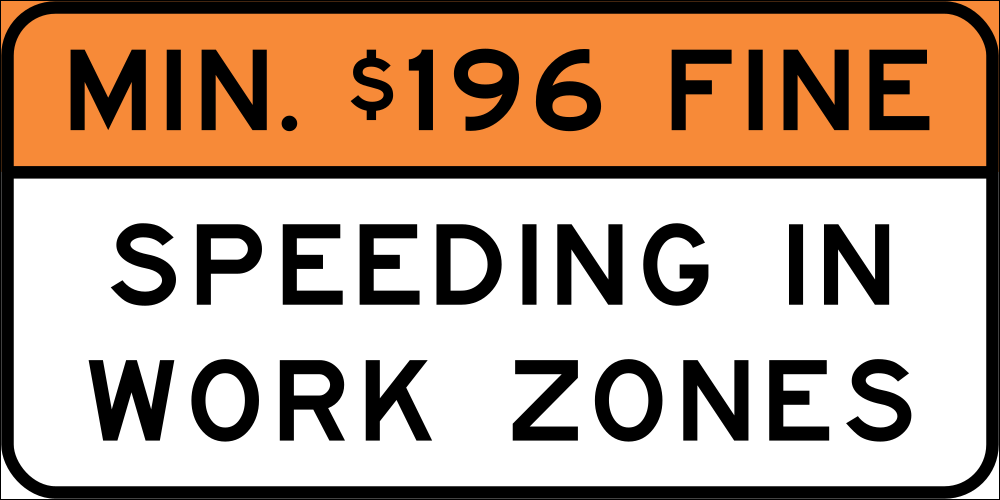
- Fines are doubled in construction zones, and you must obey the posted construction zone speed limits.
- Excessive speeding has lasting costs too: 1 or more excessive speeding convictions puts you on the Driver Risk Premium for 3 years, and a conviction for excessive speed during the novice stage disqualifies you from the Driving Record Assessment that lets clean-record drivers leave GLP without a second road test from October 19, 2026.
Signs in this section
Official source: Your licence ↗ · Sharing the road ↗ · Glp changes ↗
7.Unpaid fines, your licence and your insurance
- Any outstanding fines or debts you owe to B.C. courts, the provincial government or ICBC — including liquor fines, tolls and family maintenance arrears — must be settled before you can get or renew a driver's licence.
- Unpaid provincial violation tickets or unpaid driver penalty premiums may also affect whether you can buy or renew your Autoplan insurance.
- Having a B.C. driver's licence is a privilege, not a right. Always carry your licence when driving and keep it current; never lend it to anyone, use a licence that is not valid, or alter it in any way.
- Driver's licence and ID card fraud — false statements, using someone else's licence, letting someone use yours, or holding a fake or altered one — carries fines of $400 to $20,000, up to 6 months in prison, or both.
- Driving without a valid driver's or learner's licence, without the proper licence class, or contrary to your licence restrictions could breach your insurance coverage: if you crash, your claim may be denied and you could be responsible for your own injuries and for the damage you cause to your vehicle, other people or property.
- As a driver you must make sure the vehicle you drive has a valid, current licence plate and adequate insurance. The plate must carry an unexpired decal showing it is insured, and a driver caught without current insurance can face a large fine.
- A bad record can also raise what you pay for insurance: convictions for frequent or serious driving offences may be factored into your premium for Collision and Extended Third Party Liability coverage.
Official source: Your licence ↗ · Driver penalty points ↗